
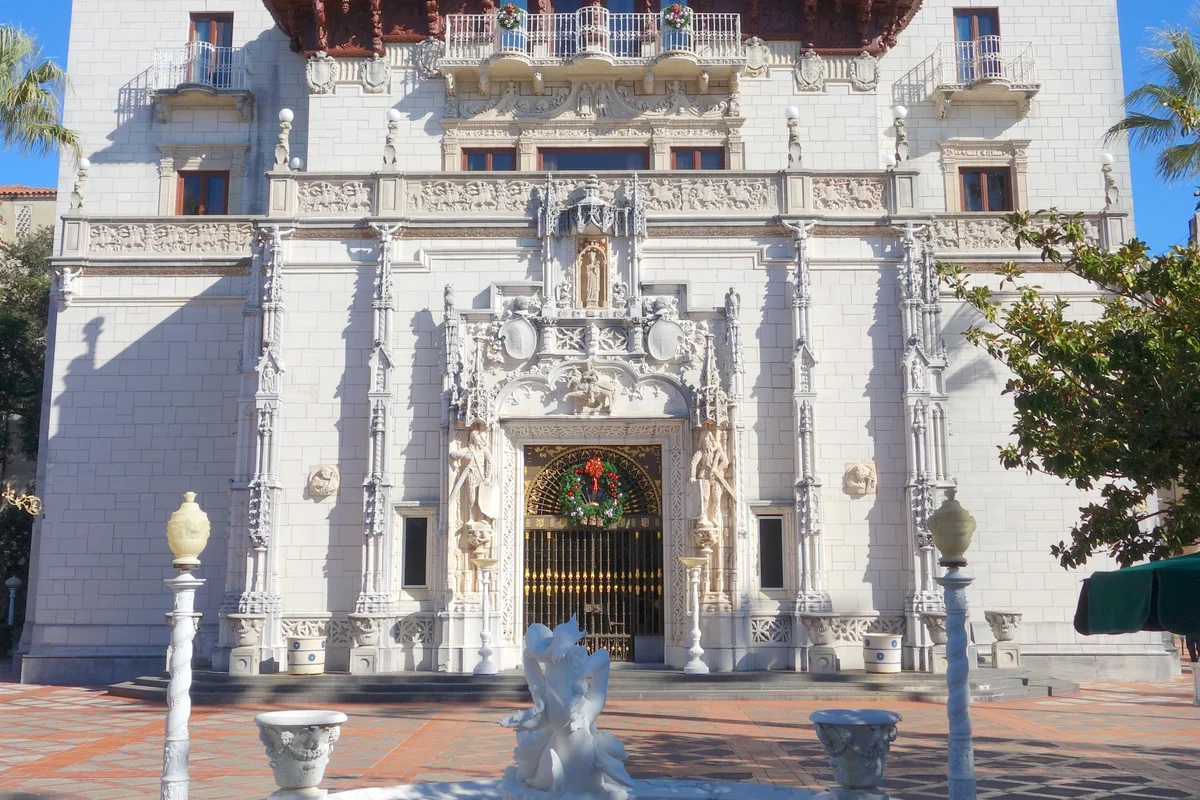
Hearst Castle, and why one tour never covers all of it
Four buildings, 165 rooms and 127 acres, built over nearly thirty years by a publisher and an architect who never quite called it finished.
William Randolph Hearst inherited a working cattle ranch above San Simeon from his mother and, starting in 1919, hired the architect Julia Morgan to turn a stretch of it into what he called, with some understatement, "a little something." What resulted over the next twenty-eight years was four separate houses, 165 rooms, and 127 acres of terraced gardens, pools and walkways — a project the two of them worked on together for the rest of Morgan's professional life, adding and revising rooms even after Hearst had already moved in and started hosting guests.
Morgan's engineering is easy to miss and worth knowing about before you go: behind the imported antique ceilings and salvaged European stonework is a steel-reinforced concrete frame, an unusual and deliberately chosen structural system for a building styled to look centuries old. It is also, not coincidentally, part of why the estate survived California's seismic history largely intact.
None of the standard guided tours attempts to cover the whole estate in one visit — it is too large, and the two halves of Casa Grande alone involve enough stairs and square footage to make combining them a genuinely long day. Understanding the layout below is the fastest way to work out which tour, or which combination, actually matches what you want to see.
Casa Grande
The main house, and the building most people picture when they hear "Hearst Castle" — twin bell towers modelled loosely on a Spanish cathedral facade, with the Assembly Room, Refectory and theater on the ground floor and Hearst's private study and guest suites above.
Julia Morgan's engineering
Behind the antique ceilings and salvaged stonework sits a steel-reinforced concrete frame — an unusual choice for a building meant to look centuries old, and one Morgan specified deliberately to survive California earthquakes.
The Neptune Pool
The Greco-Roman colonnade and pool that has become the estate's signature image, reportedly rebuilt more than once at Hearst's insistence until the proportions satisfied him. It no longer holds water for swimming, but it remains the single most photographed spot on the property.
The grounds and cottages
127 acres of terraced gardens and walkways connect Casa Grande to three guest cottages — Casa del Sol, Casa del Monte and Casa del Mar — each grand enough to be a notable house on its own, set among planting that took decades to mature.
History
From working ranch to National Historic Landmark
Hearst hosted a genuinely remarkable range of guests at the ranch through the 1920s and 1930s — actors, directors, journalists and politicians arrived for weekends that sometimes stretched into weeks, with dinners in the Refectory and films screened in the estate's own theater before they opened anywhere else in the country. The property also kept what was reportedly the largest private zoo in the world; most animals were dispersed to other collections after Hearst's finances tightened in the late 1930s, but the free-roaming zebras were never gathered up, and their descendants still graze the surrounding ranchland today.
Hearst left the estate for the last time in 1947 for health reasons and never returned. His family donated the main property to the State of California in 1957, and it opened to the public the following year. It was named a California Historical Landmark in 1958, listed on the National Register of Historic Places in 1972, and designated a National Historic Landmark in 1976 — recognition that runs alongside, not instead of, its ongoing life as a working state park with a genuine restoration program.
Common questions
Hearst Castle, answered
- Who built Hearst Castle, and when?
- William Randolph Hearst, the newspaper publisher, and architect Julia Morgan, who he hired in 1919 and worked with for the better part of three decades. Construction ran from 1919 until 1947, though the estate was never formally declared finished — Hearst kept modifying it for as long as he lived there.
- How big is Hearst Castle?
- The estate comprises four separate houses totaling roughly 90,000 square feet of living space and 165 rooms, including 56 bedrooms and 61 bathrooms, spread across 127 acres of gardens, terraces, pools and walkways on a hill above San Simeon.
- Is Hearst Castle a National Historic Landmark?
- Yes. It was named a California Historical Landmark in 1958, added to the National Register of Historic Places in 1972, and designated a National Historic Landmark in 1976. It has been operated as a unit of the California state park system since Hearst's family donated it to the state in 1957.
- Why is Hearst Castle called a castle if it isn't one?
- Hearst himself called it "the ranch" and the main house Casa Grande — nobody on the property called it a castle. The name is a later convenience: what stands here is closer to a Mediterranean Revival hilltop estate than a fortified castle, built for entertaining rather than defense.
- Can you still see the zebras Hearst kept?
- Descendants of them, yes, sometimes. Hearst kept what was reportedly the largest private zoo in the world on the surrounding ranchland in the estate's heyday. Most animals were sold or donated after Hearst's finances tightened in the late 1930s, but free-roaming zebras were never rounded up, and their descendants still graze the hills you pass on Highway 1 near San Simeon.
- Do you need to buy a separate ticket for each part of the estate?
- Each guided tour covers different ground — Casa Grande's ground floor, its upper floors, two of the guest cottages, or Casa del Sol and the North Wing — because no single tour covers the whole estate in a reasonable time. The tour list on the homepage is the place to compare them.
Where to start
The two tours that cover Casa Grande
Between them, these two tours cover the whole of the main house — the ground floor Hearst entertained in, and the upper floors he actually lived in.
Grand Rooms Tour
The tour almost everyone means when they say they're going to Hearst Castle — the ground-floor rooms William Randolph Hearst actually entertained in.
Upstairs Suites Tour
The rooms Hearst kept for himself and his closest guests, up in the bell towers most visitors only ever see from the lawn.